#EnterpriseSaaS
#UI/UX
#System Design
Order Management System Redesign
Order Management System Redesign
Order Management System Redesign
Order Management System Redesign
Order Management System Redesign
Order Management System Redesign
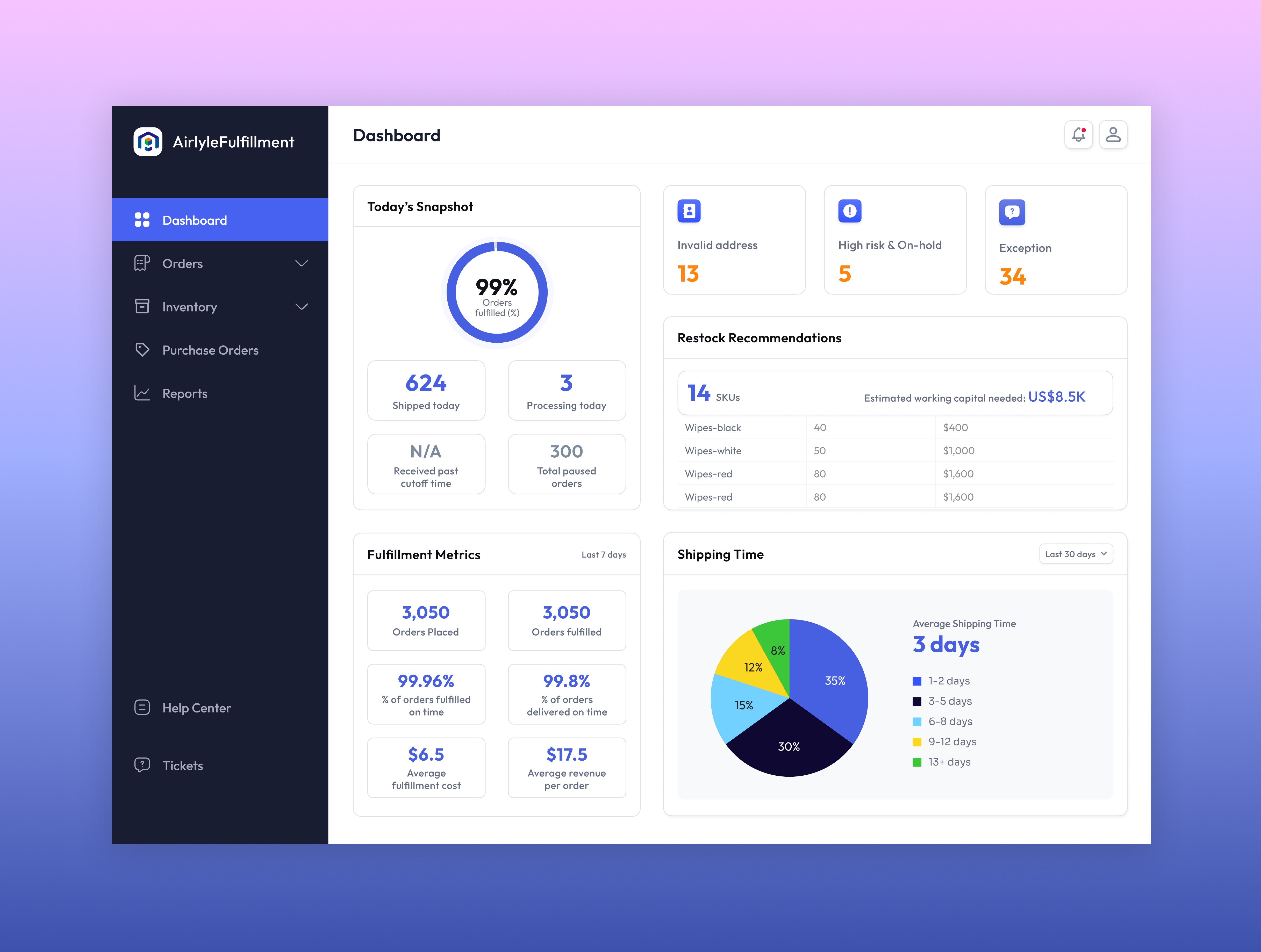
At Airlyle Fulfillment, a third-party fulfillment company, we help e-commerce sellers handle the heavy lifting—literally. From warehousing inventory to fulfilling orders as they roll in, we make sure products get to the right customers at the right time.
But here's the catch: the Order Management System (OMS), a core tool for clients to track stock, orders, and inventory, was in trouble. It was outdated, hard to navigate, and lacking key features. The result?
Endless email threads.
Frustrated clients.
Bottlenecks everywhere.
As the company scaled, these cracks in the system only got wider. Enter me, tasked with giving the OMS a much-needed facelift and injecting transparency into every corner of the process.
At Airlyle Fulfillment, a third-party fulfillment company, we help e-commerce sellers handle the heavy lifting—literally. From warehousing inventory to fulfilling orders as they roll in, we make sure products get to the right customers at the right time.
But here's the catch: the Order Management System (OMS), a core tool for clients to track stock, orders, and inventory, was in trouble. It was outdated, hard to navigate, and lacking key features. The result?
Endless email threads.
Frustrated clients.
Bottlenecks everywhere.
As the company scaled, these cracks in the system only got wider. Enter me, tasked with giving the OMS a much-needed facelift and injecting transparency into every corner of the process.
At Airlyle Fulfillment, a third-party fulfillment company, we help e-commerce sellers handle the heavy lifting—literally. From warehousing inventory to fulfilling orders as they roll in, we make sure products get to the right customers at the right time.
But here's the catch: the Order Management System (OMS), a core tool for clients to track stock, orders, and inventory, was in trouble. It was outdated, hard to navigate, and lacking key features. The result?
Endless email threads.
Frustrated clients.
Bottlenecks everywhere.
As the company scaled, these cracks in the system only got wider. Enter me, tasked with giving the OMS a much-needed facelift and injecting transparency into every corner of the process.
At Airlyle Fulfillment, a third-party fulfillment company, we help e-commerce sellers handle the heavy lifting—literally. From warehousing inventory to fulfilling orders as they roll in, we make sure products get to the right customers at the right time.
But here's the catch: the Order Management System (OMS), a core tool for clients to track stock, orders, and inventory, was in trouble. It was outdated, hard to navigate, and lacking key features. The result?
Endless email threads.
Frustrated clients.
Bottlenecks everywhere.
As the company scaled, these cracks in the system only got wider. Enter me, tasked with giving the OMS a much-needed facelift and injecting transparency into every corner of the process.
At Airlyle Fulfillment, a third-party fulfillment company, we help e-commerce sellers handle the heavy lifting—literally. From warehousing inventory to fulfilling orders as they roll in, we make sure products get to the right customers at the right time.
But here's the catch: the Order Management System (OMS), a core tool for clients to track stock, orders, and inventory, was in trouble. It was outdated, hard to navigate, and lacking key features. The result?
Endless email threads.
Frustrated clients.
Bottlenecks everywhere.
As the company scaled, these cracks in the system only got wider. Enter me, tasked with giving the OMS a much-needed facelift and injecting transparency into every corner of the process.
At Airlyle Fulfillment, a third-party fulfillment company, we help e-commerce sellers handle the heavy lifting—literally. From warehousing inventory to fulfilling orders as they roll in, we make sure products get to the right customers at the right time.
But here's the catch: the Order Management System (OMS), a core tool for clients to track stock, orders, and inventory, was in trouble. It was outdated, hard to navigate, and lacking key features. The result?
Endless email threads.
Frustrated clients.
Bottlenecks everywhere.
As the company scaled, these cracks in the system only got wider. Enter me, tasked with giving the OMS a much-needed facelift and injecting transparency into every corner of the process.
June 2024 - present
Timeline
UX Designer
Role
June 2024 - present
Timeline
UX Designer
Role
Tools
Tools
Figma
Illustrator
"It's not okay to have us send millions of emails and tickets to get the info when you already have a system for us."
— Omar, Clean Skin Club
The Problem
The Problem
The issue boiled down to one thing: lack of transparency. Clients needed better visibility into order statuses, inventory data, and workflows—all in one place.
The issue boiled down to one thing: lack of transparency. Clients needed better visibility into order statuses, inventory data, and workflows—all in one place.
My goal
My goal
Reduce emails and support tickets.
Empower clients with the data they need.
Make the OMS a tool they can trust.
Reduce emails and support tickets.
Empower clients with the data they need.
Make the OMS a tool they can trust.
Discovery
Building Context in a New Industry
Discovery
Building Context in a New Industry
One of the biggest challenges in this project? I had to quickly immerse myself in the world of e-commerce and fulfillment. If I didn’t understand how things worked, how could I design a system that did?
One of the biggest challenges in this project? I had to quickly immerse myself in the world of e-commerce and fulfillment. If I didn’t understand how things worked, how could I design a system that did?
How I Tackle It
How I Tackle It
1
Became a logistics student
Researched how e-commerce sellers use OMS tools: tracking stock, managing orders, deciding where to ship. Mapped the system’s architecture (think: a messy mind map that slowly made sense).
1
Became a logistics student
Researched how e-commerce sellers use OMS tools: tracking stock, managing orders, deciding where to ship. Mapped the system’s architecture (think: a messy mind map that slowly made sense).
1
Became a logistics student
Researched how e-commerce sellers use OMS tools: tracking stock, managing orders, deciding where to ship. Mapped the system’s architecture (think: a messy mind map that slowly made sense).
2
Workshops with the ops team
Asked Airlyle’s team: “What’s the #1 thing clients complain about?” Prioritized pain points: “FBA requests” (sending stock to Amazon warehouses) topped the list.
2
Workshops with the ops team
Asked Airlyle’s team: “What’s the #1 thing clients complain about?” Prioritized pain points: “FBA requests” (sending stock to Amazon warehouses) topped the list.
2
Workshops with the ops team
Asked Airlyle’s team: “What’s the #1 thing clients complain about?” Prioritized pain points: “FBA requests” (sending stock to Amazon warehouses) topped the list.
3
Client interviews
Shadowed users like Omar. Watched them toggle between 5 tabs and 3 spreadsheets just to check inventory. Key insight: Unclear FBA statuses = panic emails.
3
Client interviews
Shadowed users like Omar. Watched them toggle between 5 tabs and 3 spreadsheets just to check inventory. Key insight: Unclear FBA statuses = panic emails.
3
Client interviews
Shadowed users like Omar. Watched them toggle between 5 tabs and 3 spreadsheets just to check inventory. Key insight: Unclear FBA statuses = panic emails.
Selected Project
Fixing the FBA Replenishment Nightmare
Selected Project
Fixing the FBA Replenishment Nightmare
The feature causing 70% of support tickets.
The old way:
Clients requested FBA shipments through a email/ticket, then… radio silence. They’d spam emails asking: “Did my stock ship? Is it at Amazon yet? Why is this delayed?”
The feature causing 70% of support tickets.
The old way:
Clients requested FBA shipments through a email/ticket, then… radio silence. They’d spam emails asking: “Did my stock ship? Is it at Amazon yet? Why is this delayed?”
Redesign Approach
Redesign Approach
1
New "Replenishment" page
This page wasn’t just for FBA requests—it also streamlined all warehouse-to-warehouse stock transfers, replacing processes that previously required endless email chains.
1
New "Replenishment" page
This page wasn’t just for FBA requests—it also streamlined all warehouse-to-warehouse stock transfers, replacing processes that previously required endless email chains.
1
New "Replenishment" page
This page wasn’t just for FBA requests—it also streamlined all warehouse-to-warehouse stock transfers, replacing processes that previously required endless email chains.
2
Tracking FBA shipments with ease
Real-time status (e.g., “In Transit,” “Arrived at Amazon”) Delay alerts with reasons (e.g., “Weather hold”) Estimated arrival countdown
2
Tracking FBA shipments with ease
Real-time status (e.g., “In Transit,” “Arrived at Amazon”) Delay alerts with reasons (e.g., “Weather hold”) Estimated arrival countdown
2
Tracking FBA shipments with ease
Real-time status (e.g., “In Transit,” “Arrived at Amazon”) Delay alerts with reasons (e.g., “Weather hold”) Estimated arrival countdown
Design Decision
Long Form Fatigue vs. Bite-Sized Wins: Why We Chunked the FBA Process
Design Decision
Long Form Fatigue vs. Bite-Sized Wins: Why We Chunked the FBA Process
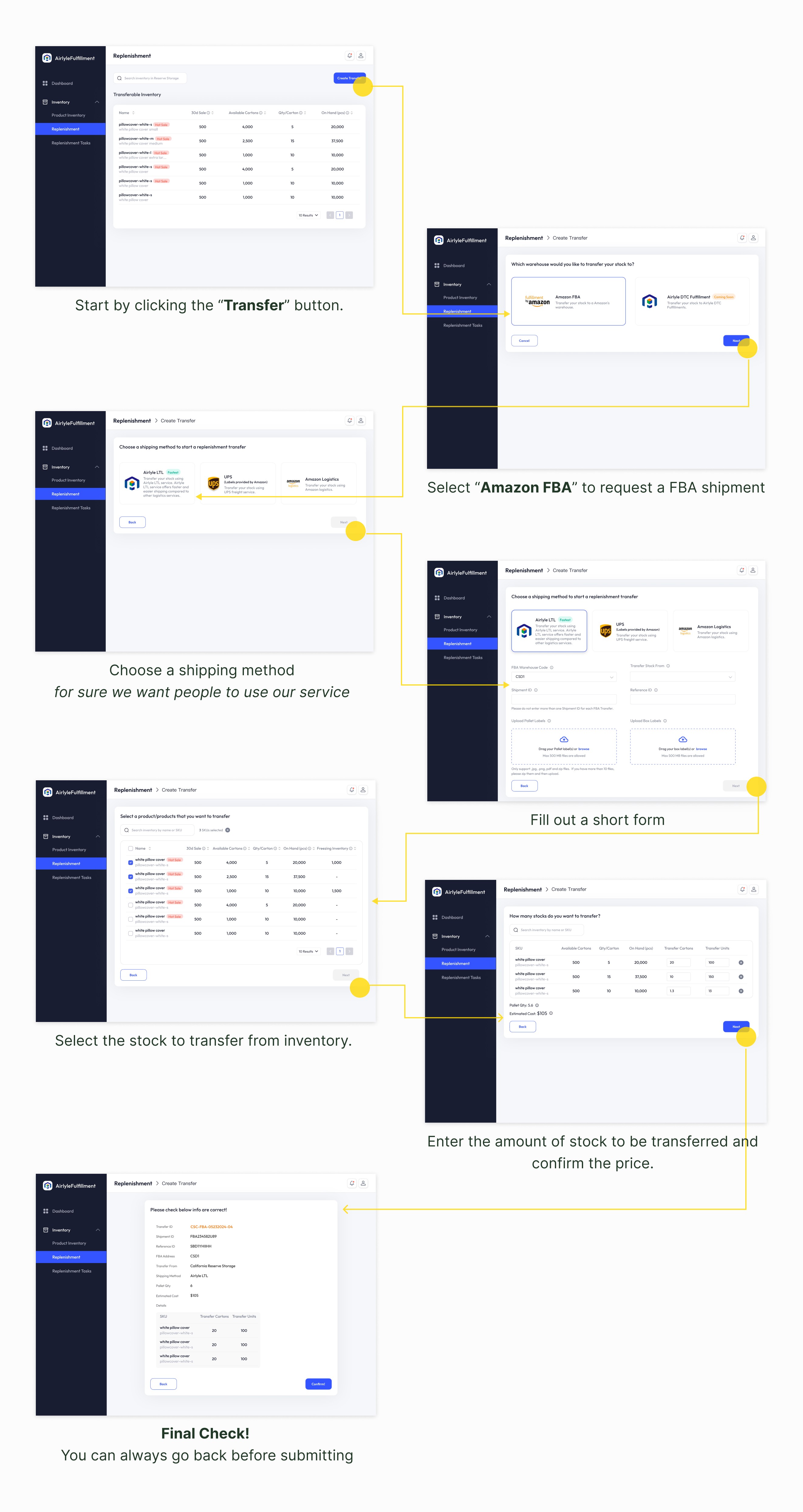
For the FBA transfer workflow, I chose to break the process into bite-sized pages, even though it meant extra development time and a few more clicks for users. Why? Testing revealed that shorter steps reduced errors by 30% (clients kept misplacing SKU numbers in the old form) and made the process feel less intimidating.
One user put it perfectly: “This feels like a conversation, not a tax form.” While the multi-page approach isn’t perfect, prioritizing clarity over speed paid off: during testing, 9/10 clients preferred this method, citing less mental fatigue. Sometimes, a little friction today saves a hundred support tickets tomorrow.
For the FBA transfer workflow, I chose to break the process into bite-sized pages, even though it meant extra development time and a few more clicks for users. Why? Testing revealed that shorter steps reduced errors by 30% (clients kept misplacing SKU numbers in the old form) and made the process feel less intimidating.
One user put it perfectly: “This feels like a conversation, not a tax form.” While the multi-page approach isn’t perfect, prioritizing clarity over speed paid off: during testing, 9/10 clients preferred this method, citing less mental fatigue. Sometimes, a little friction today saves a hundred support tickets tomorrow.